

The Net Zero Talent Gap: IICSR Enters A Market Where Corporate Climate Targets Are Outpacing Skills
IICSR LOGO
Corporate Net Zero targets are rising faster than skills. IICSR’s Masters in Net Zero responds to the growing demand for implementation-ready professionals.
MANHATTAN, NY, UNITED STATES, September 14, 2026 /EINPresswire.com/ -- Yes. The main issue is that the previous version spends too much time explaining IICSR's differentiators and uses language such as “distinguish,” “strengthens,” and “opportunity,” which makes it read like branded content. For a Forbes-style news article, IICSR should appear as **one response to a larger market trend**, not as the subject of praise.I would rewrite it along these lines:
# The Net Zero Talent Gap: Corporate Climate Targets Are Outpacing The Professionals Needed To Deliver Them
Thousands of companies have committed to reaching Net Zero, but a less visible challenge is beginning to emerge behind those targets: finding enough people with the skills to implement them.
Corporate climate commitments have expanded rapidly over the past several years. The Science Based Targets initiative, or SBTi, currently lists more than 14,000 companies with validated targets or commitments, including close to 2,800 companies with validated Net Zero targets. SBTi reported that the number of companies with validated science-based targets increased by 40% during 2025, while the number with validated Net Zero targets rose by 61%.
Among the world's largest businesses, Net Zero commitments are already mainstream. Net Zero Tracker's 2025 assessment found that 63% of Forbes Global 2000 companies had announced Net Zero targets. Those companies collectively represented approximately $36.6 trillion in annual revenue, equivalent to about 70% of the revenues represented by the index.
Yet having a target does not necessarily mean having a credible route to achieve it. Of the 1,245 Forbes Global 2000 companies identified as having a Net Zero target in the Net Zero Tracker assessment, 860 had an accompanying plan. That leaves hundreds of major corporations with a stated destination but without a sufficiently clear roadmap for reaching it.
That gap between commitment and execution is likely to shape the next phase of corporate climate action.
## The Net Zero Skills Gap Is Becoming A Business Issue
Implementing Net Zero is considerably more complicated than announcing it. A company first needs to understand what it emits and where those emissions occur. It then needs to decide what can be eliminated, which technologies are viable, how much transition will cost and how progress will be measured.
For many businesses, Scope 3 emissions make that task particularly complicated because they can extend across suppliers, logistics networks, purchased products, investments and the use of goods sold to customers. Companies may therefore depend on data and decisions made by organisations they do not directly control.
Decarbonisation can also involve decisions normally associated with engineering, finance and corporate strategy rather than traditional sustainability functions. Manufacturers may need to consider electrification or alternative production processes. Procurement teams may need to work with suppliers on emissions reduction. Finance departments may need to evaluate transition investments. Legal and compliance teams increasingly need to understand climate-related regulations and disclosure requirements.
This is beginning to show up in labour-market data.
LinkedIn's 2025 Global Green Skills research found that demand for green talent was growing at roughly twice the rate at which green skills were being added to the workforce: 8% compared with 4%. Workers with green skills were also being hired at a rate around 47% above the overall workforce.
The more significant finding may be where those skills are being used. Green competencies are increasingly appearing in jobs that would not traditionally have been classified as environmental roles. That suggests the transition could change the requirements of mainstream business functions rather than merely creating additional sustainability departments.
The World Economic Forum's *Future of Jobs Report 2025* estimates that climate-change adaptation could result in approximately 5 million net additional jobs worldwide by 2030, while climate mitigation could contribute another 3 million. Changes in energy generation, storage and distribution could add roughly another 1 million net positions.
These are not forecasts for nine million Net Zero specialists. Many of those jobs will be in engineering, construction, energy and technical occupations. But they indicate how extensively the climate and energy transitions are expected to affect employment.
For companies, the implication is that the sustainability skills problem is increasingly a workforce-planning problem.
Carbon accountants, emissions-verification specialists, renewable-energy professionals, industrial decarbonisation engineers, sustainable-finance professionals, Scope 3 specialists and carbon-market practitioners are likely to form part of the expanding ecosystem. At the same time, existing accountants, engineers, procurement executives, lawyers and financial professionals may need additional climate-related competencies.
## A New Market For Net Zero Education Is Taking Shape
Educational institutions and professional bodies have begun responding to the demand.
Courses carrying Net Zero explicitly in their names now range from short introductory programmes to executive courses and longer professional training.
| Institution | Programme | Approximate duration | Main focus |
| ------------------------------------------- | ------------------------------------------------- | --------------------------------------: | ------------------------------------------- |
| United Nations University – IAS | Net Zero 101: What, Why and How | 60–90 minutes | Introductory Net Zero literacy |
| Energy Institute, UK | Net Zero for Professionals | 20 hours self-paced or 2 days classroom | Organisational Net Zero strategy |
| ISEP | Pathways to Net Zero | 2 days / 14 guided hours | Decarbonisation strategy and implementation |
| Nalanda University | Executive Certificate Course in Net-Zero Strategy | 5 days | Executive Net Zero planning |
| IICSR & Sustainability Knowledge Management | Masters in Net Zero | 6 months | Multi-disciplinary practitioner training |
The range illustrates how broad the market has become.
The United Nations University's **Net Zero 101: What, Why and How** is intended as an introductory programme and can be completed in roughly an hour to an hour and a half. UNU reported more than 15,000 enrolments and over 8,000 certificates issued through the programme during 2024, suggesting significant demand even for basic Net Zero literacy.
The UK's Energy Institute offers **Net Zero for Professionals**, which can be taken as a 20-hour self-paced course or through two days of classroom training. The curriculum covers areas including climate science, greenhouse-gas accounting principles, target-setting and organisational Net Zero strategy.
ISEP's **Pathways to Net Zero** is a two-day professional programme designed for people involved in developing or supporting organisational Net Zero strategies, while Nalanda University has offered an executive certificate course in Net-Zero Strategy structured over five days.
A longer programme has also entered the market from India's International Institute of Corporate Sustainability and Responsibility, or IICSR, together with Sustainability Knowledge Management.
Its **Masters in Net Zero** is structured as a six-month professional programme. According to the programme document, the curriculum covers climate science, Net Zero frameworks, Scope 1, Scope 2 and Scope 3 accounting, the GHG Protocol, renewable energy, energy efficiency, industrial decarbonisation, carbon capture, climate technology, carbon markets and transition planning.
Advanced components include circular economy, artificial intelligence for sustainability, Direct Air Capture, BECCS, nature-based solutions, green finance, MRV systems, blockchain-enabled traceability and international carbon-market regulation.
The programme also incorporates an ISO 14064 series covering organisational greenhouse-gas inventories, emission-reduction and removal projects, and validation and verification. Participants undertake assignments involving emissions calculations, Net Zero roadmaps, KPIs and industry projects, according to the curriculum.
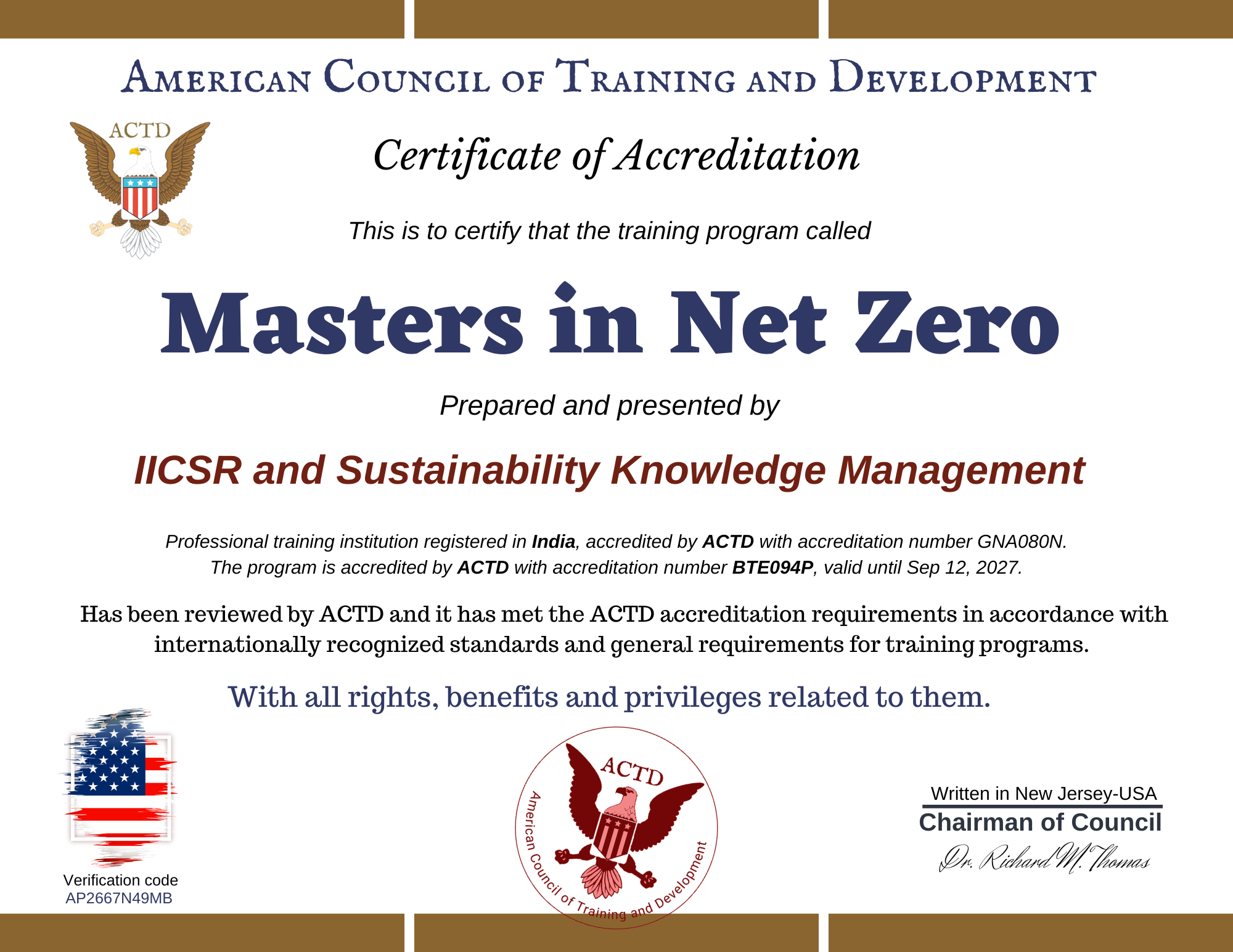
The course has been accredited as a professional training programme by the American Council of Training and Development. ACTD's certificate lists programme accreditation number BTE094P, valid until September 12, 2027, and identifies IICSR and Sustainability Knowledge Management as an accredited professional training institution under number GNA080N.
The credential is professional-training accreditation rather than a university academic master's degree, an important distinction when comparing it with conventional postgraduate qualifications.
The existence of programmes ranging from 90 minutes to six months also highlights that there is not yet a single accepted educational route into Net Zero work. Different employers may require very different levels of expertise.
Someone in a senior management role may need enough knowledge to evaluate strategy. A carbon accountant needs more technical competence. An engineer working on industrial decarbonisation requires a different skill set again.
The market may therefore evolve in a similar way to other professional fields, with introductory qualifications sitting alongside specialist training, professional accreditation and formal academic degrees.
## From Corporate Targets To A Net Zero Workforce
The more difficult question is whether training capacity can develop quickly enough.
The corporate demand side is already substantial. Almost two-thirds of Forbes Global 2000 companies have Net Zero targets, while thousands of businesses have formal science-based climate commitments. Green skills, meanwhile, are being added to the labour market more slowly than employers are seeking them.
Those dynamics could create opportunities for both specialists and professionals transitioning from existing occupations.
A conventional accountant, for example, may add carbon-accounting and assurance skills. An engineer may specialise in low-carbon production. Procurement managers may develop expertise in supplier emissions. Financial professionals may move into transition finance or climate investment. Lawyers may increasingly work on disclosure, carbon markets and emerging environmental regulation.
Not all of these people will carry “Net Zero” in their job titles. In fact, the spread of green skills into conventional occupations suggests that many will not.
That may be one reason why attempts to estimate the number of future Net Zero jobs are difficult. The transition is less likely to create a completely separate workforce than to reshape parts of the existing one.
Education providers are also experimenting with different ways of connecting formal learning with industry.
IICSR, for instance, is developing CSO Roundtables and the International Net Zero Summit 2027 alongside its training programmes. Those initiatives are intended to bring corporate sustainability executives, technology providers and other stakeholders into discussions about implementation challenges.
Such initiatives are not unique to IICSR; professional bodies, universities, industry associations and climate organisations globally are similarly trying to reduce the distance between classroom knowledge and rapidly changing industry practice.
That linkage may become increasingly important because there is no universal Net Zero pathway.
A cement company dealing with process emissions has little in common operationally with a bank addressing financed emissions. Aviation, real estate, steel, consumer goods and information technology each face different technical, regulatory and financial constraints.
Training that remains purely generic may therefore have limited value for professionals expected to implement change in specific sectors.
At the same time, employers will need to decide which skills genuinely matter. The growth of climate-related courses also creates a risk of credential proliferation, where the number of certificates increases faster than agreement on professional standards.
Accreditation, technical standards and evidence of applied competency may consequently become more important as the training market expands.
Net Zero work also involves a significant degree of uncertainty. Technologies will change, carbon-market rules will evolve and disclosure requirements will continue to develop. Some technologies viewed as promising today may fail to scale economically, while others may become commonplace.
Professionals entering the field will therefore require continuing education rather than a one-time qualification.
That is likely to favour people able to combine foundational knowledge with sector expertise and practical experience.
The economic opportunity should also be considered alongside the risk. A shortage of appropriately skilled people can increase the cost of implementing climate strategies, particularly if companies compete for a limited pool of experienced practitioners. Conversely, workers who acquire relevant skills while demand remains ahead of supply may benefit from increased mobility.
LinkedIn's finding that green-skilled workers are being hired at substantially higher rates than the wider workforce provides an early indication of that possibility.
For employers, however, simply hiring a sustainability professional will not solve the problem.
A credible Net Zero transition involves organisational change. Finance, operations, procurement, product development, technology and senior management all have roles to play. The ultimate skills challenge may therefore involve spreading climate competence across organisations rather than building isolated teams.
This also changes how Net Zero education should be evaluated.
The relevant question is not merely whether a course covers carbon accounting or climate science. It is whether participants can use that knowledge to make better decisions inside companies.
Can they establish a credible emissions baseline? Can they distinguish between reductions and offsets? Can they evaluate a decarbonisation project economically as well as environmentally? Can they identify where carbon claims require external verification? Can they develop targets that translate into operational milestones?
Those capabilities will become increasingly important as companies move closer to interim climate deadlines.
The next few years are particularly significant because many organisations have 2030 targets. Unlike distant 2050 commitments, those deadlines now sit within normal corporate investment and strategic-planning cycles.
The transition from target-setting to implementation is therefore already underway.
That makes the green-skills gap more than a theoretical workforce problem.
It has the potential to become a constraint on corporate climate delivery.
The world has spent years counting Net Zero commitments. The next stage will require measuring something more difficult: whether organisations possess the people, expertise and institutional capacity required to achieve them.
For the emerging education market, including programmes offered by organisations such as UNU, the Energy Institute, ISEP, Nalanda University and IICSR, the opportunity will depend on whether employers ultimately value those skills and whether graduates can demonstrate practical capability.
For companies, the challenge is more immediate.
Targets have been set. Deadlines are approaching. Transition plans now have to move into capital budgets, factories, procurement systems and supply chains.
The next bottleneck in Net Zero may not be another commitment.
It may be the availability of people who know what to do next.
Nitisha Kerkar
IICSR and Sustainability Knowledge Management
+1 628-278-3652
email us here
Visit us on social media:
LinkedIn
Instagram
Facebook
YouTube
X
Other
Legal Disclaimer:
EIN Presswire provides this news content "as is" without warranty of any kind. We do not accept any responsibility or liability for the accuracy, content, images, videos, licenses, completeness, legality, or reliability of the information contained in this article. If you have any complaints or copyright issues related to this article, kindly contact the author above.
